
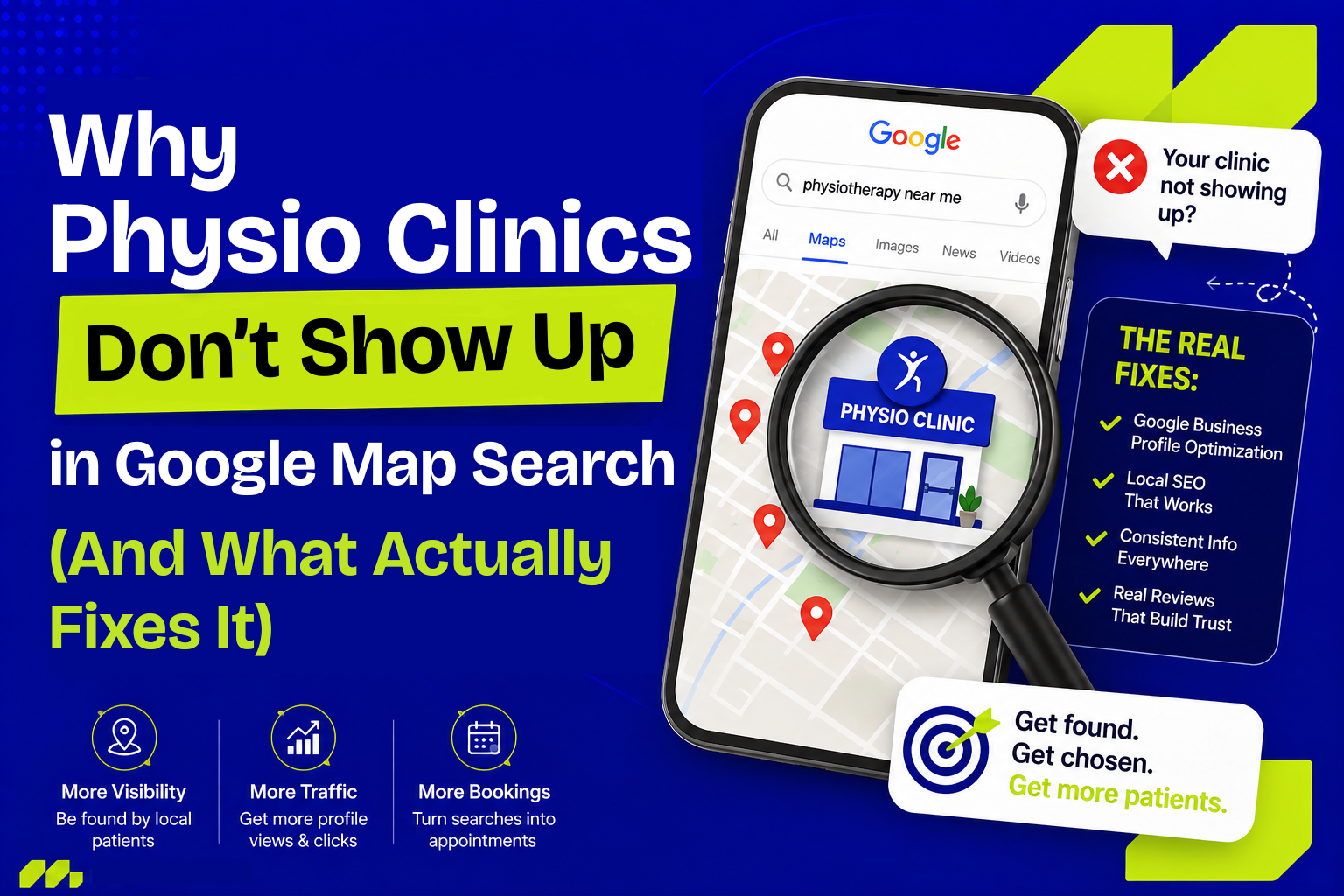
A clinic can have a decent website, a few blog posts, and still be functionally invisible where it matters most. Type "physio near me" or "physiotherapist [suburb]" into Google and the first thing most people see is not a list of blue links. It is a map with three business listings next to it. If your clinic is not one of those three, a large share of searchers will never scroll down far enough to find you, no matter how well the rest of your site is built.
This is a different problem to the ones we have covered before on this blog. It has nothing to do with your booking form or your page speed. It is about whether your clinic shows up in the room at all before a prospective patient even reaches your website.
The map pack is where most of the clicks go
The three listings that appear with the map, often called the local pack or map pack, consistently pull more attention than the organic results below them. A 2025 study by First Page Sage found the top position in the local pack captures roughly 17.6% of clicks, with the second and third positions close behind at 15.4% and 15.1%. Together, the three visible spots account for close to half of all clicks on that search. A separate study cited by RedLocalSEO found that businesses appearing in the local pack receive 126% more traffic and 93% more calls, website clicks and direction requests than businesses sitting further down the results.
The practical reading of this is blunt. Ranking fourth is not a slightly worse version of ranking first, it is close to invisible by comparison, because most searchers never look past the map.
Why a lot of clinics never get near the top three
A common assumption is that this comes down to having a nice website, but Google's local ranking works on a different set of signals almost entirely separate from how good your site looks. Three things tend to matter most in practice.
The first is a complete, accurate Google Business Profile, meaning consistent name, address, phone number and category across the listing, filled out fully rather than left half finished. Clinics that set this up once at launch and never touch it again are quietly leaving ranking signals on the table.
The second is review volume and rating, and this one has a direct, measurable effect on patient behaviour, not just search ranking. A survey of over a thousand patients and healthcare professionals by Tebra found that 45% of patients regularly read reviews before booking with a healthcare provider, 62% have avoided booking with a provider because of negative reviews, and more than a third would never book with a provider rated three stars or lower. A clinic with a handful of old reviews sitting at a mediocre average is losing patients twice over, once in the ranking itself and again when a searcher does find the listing but scrolls past it because of the rating.
The third is consistency of information across the web. If your clinic's address or phone number is listed differently on your website, your Facebook page and old directory listings, that inconsistency actively works against you in how Google evaluates whether your business is a legitimate, trustworthy local result.
What actually moves a clinic up the local pack
None of the fixes here require rebuilding anything. Claiming and fully completing the Google Business Profile is the starting point, filling in services, opening hours, photos of the actual clinic rather than stock images, and the correct category for physiotherapy specifically rather than a generic medical category.
Reviews need an actual process behind them rather than hoping satisfied patients think to leave one unprompted. The data on this is fairly consistent, most patients who would leave a positive review simply never get around to it unless asked directly, usually right after a session when the experience is still fresh. A short message asking a happy patient for a review, sent at the right moment, tends to outperform any passive request left on a website or a sign in the waiting room.
Consistency across directories matters more than most clinics realise, so checking that your listed name, address and phone number match exactly across your website, Facebook, any health directories and old citations is worth an actual afternoon rather than an assumption that it is already fine.
Where this connects to everything else on the site
A clinic that fixes its local search visibility but still has a slow website or a clunky booking form has solved the discovery problem and left the conversion problem untouched. Someone finding you in the map pack still has to get through the same booking experience we covered in a previous article, and a clinic that shows up prominently but cannot convert that visibility into an actual appointment is spending effort on the wrong end of the funnel.
The two problems are genuinely separate and both need attention, but the order matters. There is not much point optimising a booking flow that almost nobody reaches because the clinic is not visible in the first place. Getting into the map pack, and staying there, is usually the first real lever worth pulling before anything else on the site gets fine tuned.