
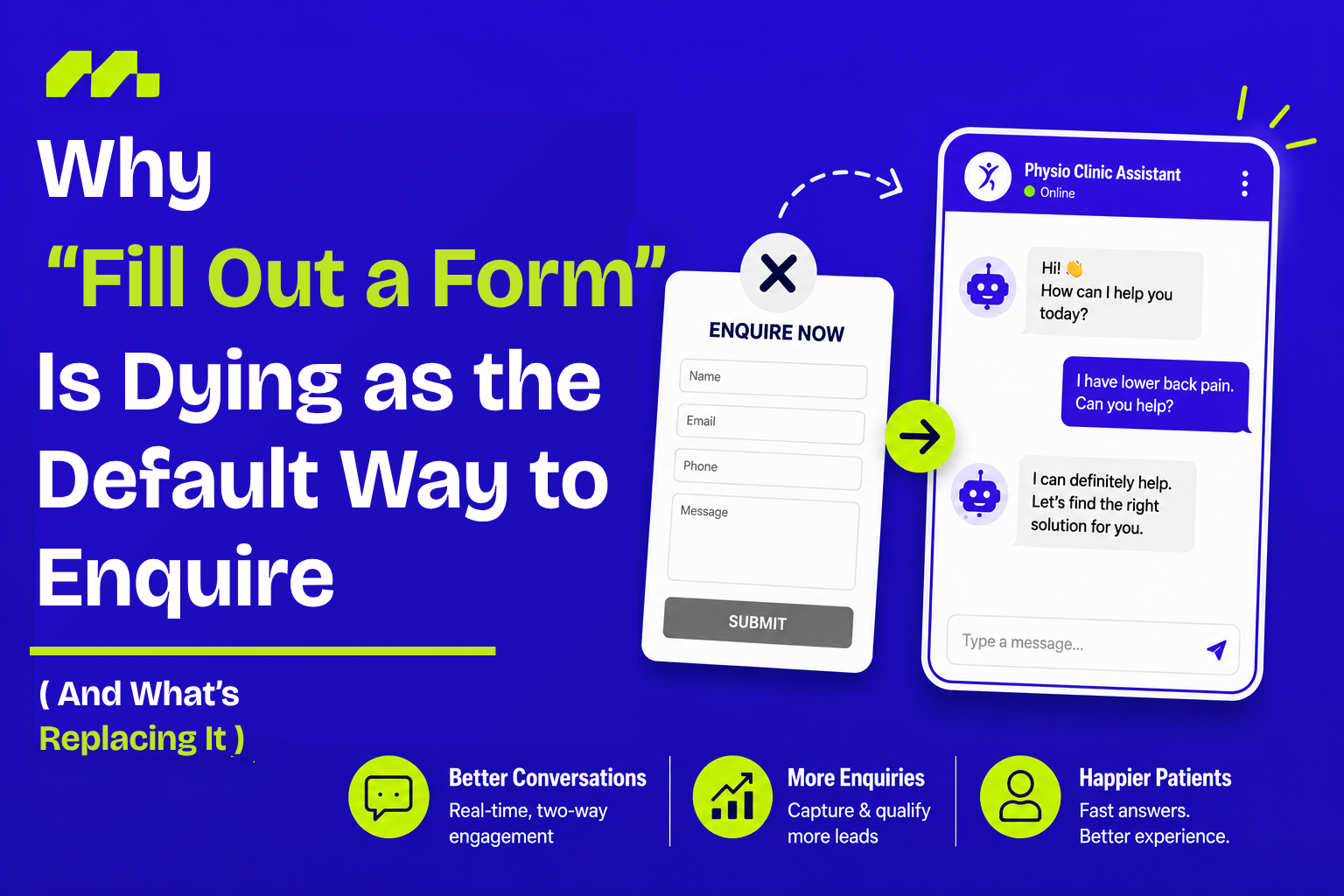
Almost every clinic website still has the same basic structure sitting somewhere near the contact page. A box for name, a box for phone number, a box for email, a dropdown for which service, and a larger box asking the visitor to describe what they need in their own words. It has been the default way to enquire online for close to two decades. It is also, increasingly, the thing costing clinics the most patients before those patients ever become a booking.
The form was never actually good, it was just normal
Static contact forms have always leaked a meaningful share of the people who start filling them in. The Baymard Institute, a usability research group that studies checkout and form behaviour in detail, found that 22% of people abandon a form specifically because the process felt too long or too complicated. A separate, more recent roundup of primary sourced form data by Crazy Egg puts overall form abandonment at roughly 32 to 34% of everyone who starts one, with contact forms specifically converting at only around 38%, meaning roughly six out of ten people who open a contact form never finish it.
None of that is new information exactly, form abandonment has been documented for years, but it has mostly been treated as a design problem to optimise around rather than a sign that the format itself is the wrong one for how people actually want to reach out today.
Even a completed form is not the end of the problem
The part that gets less attention is what happens after someone actually submits a form successfully. That enquiry does not become a patient automatically, it becomes a message sitting in an inbox waiting for someone to read it and respond, and the research on what happens during that wait is unusually well documented for a topic this specific.
The original MIT and InsideSales.com Lead Response Management Study, which analysed over 15,000 leads across multiple companies, found that contacting someone within five minutes of their enquiry makes a business 100 times more likely to actually reach that person, and 21 times more likely to qualify them, compared to waiting 30 minutes. A separate Harvard Business Review study auditing 2,241 firms found the average business takes 42 hours to respond to an inbound enquiry, and 23% never respond at all. The same research found that firms responding within an hour were roughly seven times more likely to have a meaningful conversation with the lead than those who waited even a little longer.
For a physio clinic, this means the form is often only half the leak. Even the patient who does push through and submit it is now waiting on a callback that, based on this research, is statistically more likely to arrive the next day than the same hour, if it arrives at all.
What is actually replacing the static form
The shift happening across most industries, healthcare included, is away from a static block of fields and toward something closer to a real conversation, whether that is a chat interface on the website, WhatsApp, or a similar messaging channel the patient already uses daily. The reasoning is not just about looking modern. A conversational format asks one question at a time instead of presenting all of them at once, which research from HubSpot and others has repeatedly shown reduces the cognitive load that causes people to abandon a form partway through, since answering one short question feels manageable in a way that a wall of fields does not.
The more significant shift, though, is what happens immediately after someone finishes that conversation. Instead of the enquiry sitting in an inbox for a human to eventually read, respond to and manually book, the system can respond instantly, ask the same intake questions a form would have asked, and place the patient directly into an available slot in the same exchange. That closes the exact gap the lead response research above is describing, not by making a human respond faster, but by removing the waiting period from the equation entirely.
This is not a hypothetical shift for us specifically. We built exactly this kind of lead response and booking system, where a website, WhatsApp or email enquiry is picked up, responded to, and booked directly into the calendar, logging the details automatically rather than leaving them for someone to type in later. Watching it run against a real enquiry flow made the research above feel a lot less abstract, because the gap between a form sitting unread and a conversation that books someone on the spot is exactly the gap the data has been describing for over a decade.
What this means for a clinic evaluating its own website
The practical test is simple enough to run today. Submit your own clinic's contact form as if you were a new patient and time how long it takes for a real response to arrive. If the answer is measured in hours rather than minutes, the research above suggests a meaningful share of the people submitting that same form are not waiting around, they are already looking at the next clinic on the list.
The fix is not necessarily ripping out every form on a website immediately. It is recognising that the format most clinics have treated as a neutral, safe default is actually one of the more measurable points of loss in the entire patient journey, and that the tools to close that gap now exist in a way they genuinely did not a few years ago.