
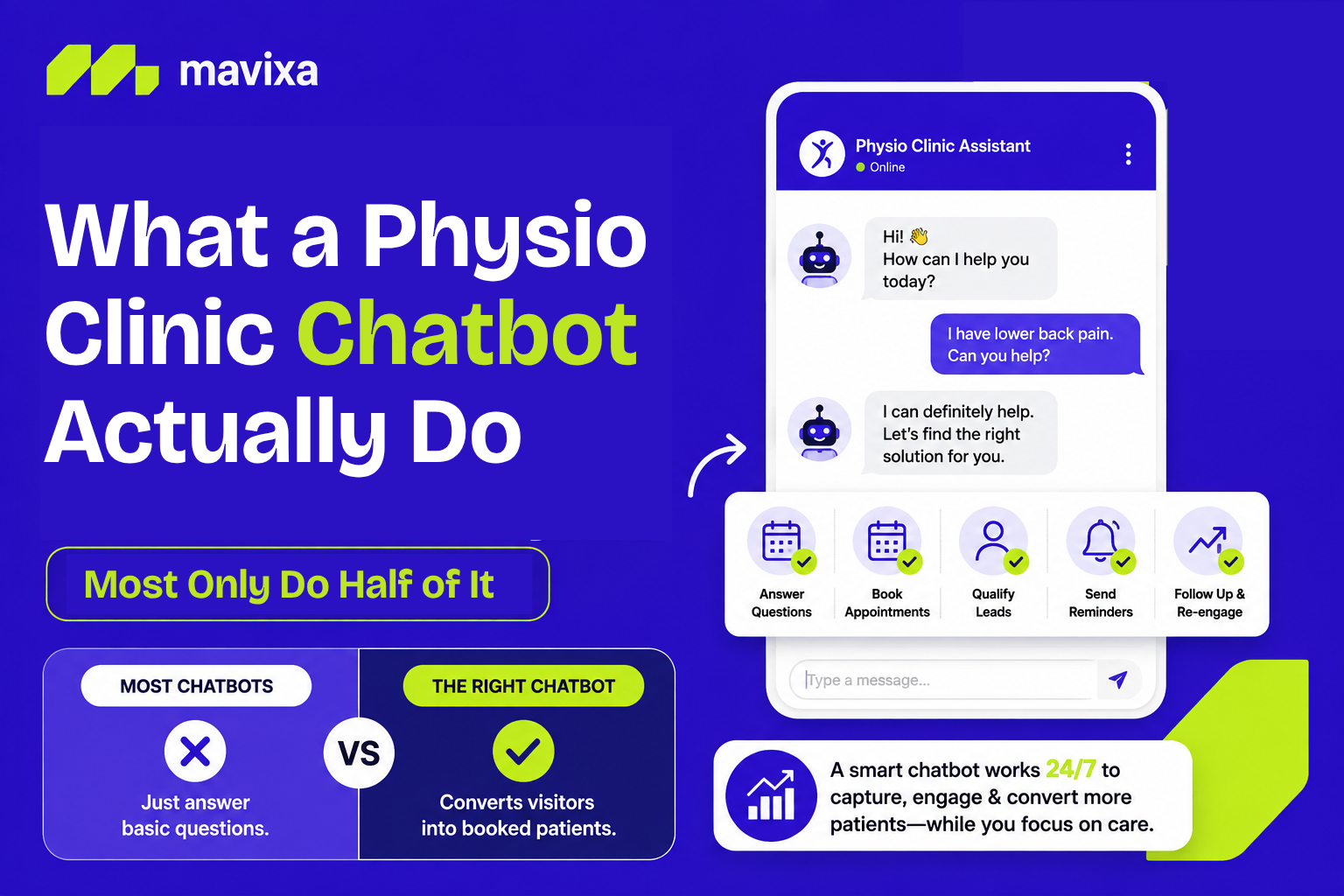
Most physiotherapy clinics that add a chatbot to their website end up with something that can answer three or four questions and not much else. It sits in the corner of the page, tells someone the clinic's opening hours, and quietly does nothing when that same person actually wants to book. That is not really a chatbot doing its job. It is a slightly interactive FAQ page.
The gap between that and something genuinely useful comes down to whether the system is built as one connected patient journey or as a pile of separate features bolted together. We have been building exactly this for physio clinics, and the reasoning behind each part is worth laying out honestly, including where the evidence is strong and where it is not.
Booking has to be the default action, not a fallback
A chatbot that answers questions but sends the visitor somewhere else to actually book has already lost half the value of being there. The point of a website chatbot is that the person never has to leave the conversation to complete what they came to do. That means the system needs to sit directly on top of the clinic's real calendar, whether that is Cliniko, HotDoc or whatever the clinic already runs, showing genuine available slots and confirming the booking in the same exchange rather than handing the visitor off to a separate form. Anything less just relocates the friction instead of removing it.
Triage is not a gimmick, it changes the outcome
Asking a few questions before booking, where the pain is, how long it has been going on, whether it is an old injury flaring up, sounds like a small feature, but the research on triage in musculoskeletal care backs up why it matters. A quality improvement study published through the UK's NHS on a digital assessment routing tool for musculoskeletal patients found that routing people to the correct level of care at first contact improved both safety and patient satisfaction, and reduced unnecessary steps in the pathway. Separately, physiotherapy triage clinics run in hospital settings have shown similarly strong results, with one Melbourne based study finding that two thirds of patients triaged by a physiotherapist did not need to see a specialist at all, because they were correctly directed to the right level of care the first time.
A clinic booking system that treats every enquiry the same, sports injury, pelvic health, paediatric, post surgical, and just drops them all into the next available slot regardless of which practitioner actually specialises in that area, is skipping a step that the wider healthcare system has already found to matter. A short triage conversation before booking is what lets a system route a hip flexor strain to a sports physio and a postnatal concern to a pelvic health specialist, instead of the patient discovering the mismatch once they are already in the room.
Reminders work, and the research on this is unusually solid
Unlike a lot of claims made about clinic automation, the evidence on appointment reminders is genuinely strong. A study published in BMC Ophthalmology tracking nearly ten thousand outpatient appointments found that patients who received an SMS reminder had a non attendance rate of 11.2%, compared to 18.1% for those who did not, a reduction of 38%. A separate systematic review covering 29 studies, published in the Journal of Telemedicine and Telecare, found automated reminders reduced non attendance by a weighted average of close to 29%, with live phone reminders performing even better at around 39%.
The honest caveat here, drawn from the same body of research, is that reminders solve forgetting, not every reason someone misses an appointment. No study in this literature gets non attendance anywhere near zero. What reminders reliably do is close the single largest and most fixable slice of the no show problem, which is exactly why it is one of the more evidence backed features to include rather than one added for the sake of looking automated.
Follow up is where most systems stop bothering, and where a lot of value sits
The period after a session tends to get the least attention from clinic technology generally, even though it is where adherence actually breaks down. Research on home exercise programmes consistently shows a wide gap between what patients are prescribed and what they actually do, and while the exact numbers vary a lot by study population, the pattern of motivation and forgetting driving dropout rather than confusion about the exercises themselves shows up repeatedly in the literature. One trial comparing video based exercise instructions to a paper handout found adherence at three months of 76% for video versus 55% for paper, which suggests that the format and the ongoing nudge matter as much as the content of the exercise plan itself.
A simple check in message a day or two after a session, asking how the area is feeling and reminding the patient of their next set of exercises, is not a replacement for clinical follow up, but it does close a gap that most clinics currently leave completely open between one appointment and the next. Without it, adherence is left entirely to the patient's own memory and motivation, which the research above suggests is not a reliable system on its own.
Why these pieces need to work as one system, not four separate ones
The reason we built booking, triage, reminders and follow up into a single connected flow rather than as standalone add-ons is that each piece depends on information the others already have. Triage data collected at the first conversation should be the same data available to whoever confirms the booking, not something re-asked later. A reminder sent before the appointment should already know what the visit is for, not just that a visit exists. A follow up message after the session should reference the actual treatment plan discussed, not a generic template. Treating these as four separate tools usually means a clinic ends up manually connecting the dots between them anyway, which defeats the purpose of automating any of it in the first place. This connected approach is the core of Mavixa's AI Front Desk process.
None of this replaces the clinical relationship between a physiotherapist and a patient. What it does is remove the administrative gaps around that relationship, the missed booking, the mismatched referral, the forgotten appointment, the exercise plan nobody followed up on, so that the time a physiotherapist actually spends with a patient is used on the things a chatbot was never meant to do.