
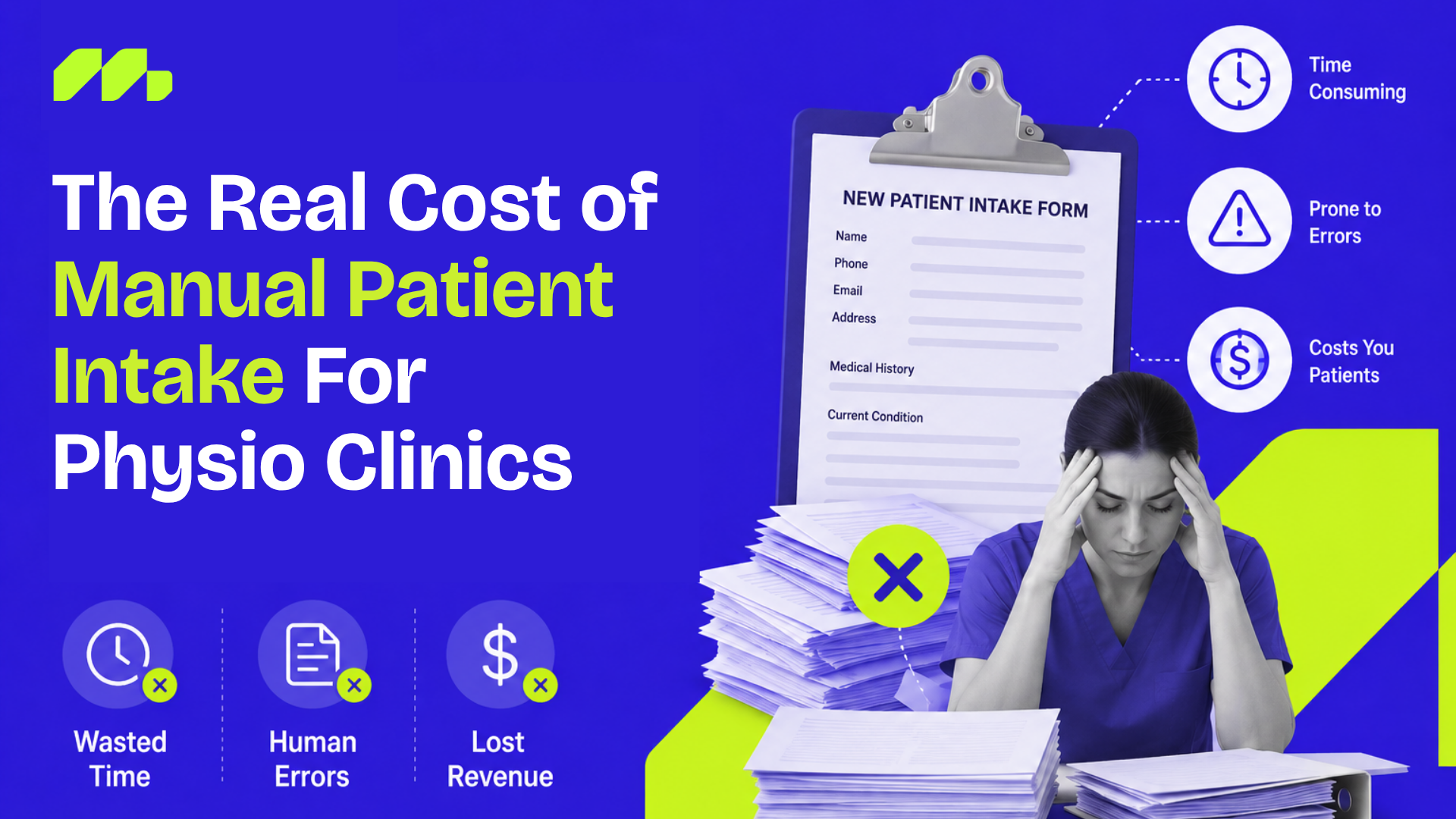
Ask a clinic owner what their intake process costs and most will say nothing, because no invoice ever arrives for it. A patient fills a paper form or a basic online one, someone at the front desk retypes it into the practice management system, checks it against their Medicare or health fund details, and files it away. It feels like a normal part of the job, not an expense. That is exactly why it never gets questioned, even though it is quietly consuming hours that could go toward things that actually grow the clinic.
Where the hours actually go
The clearest, most rigorously documented version of this problem comes from medicine broadly, not physiotherapy specifically, but the pattern transfers directly. A national US survey of 4,720 physicians, published in the peer reviewed Journal of General Internal Medicine, found doctors spend an average of 8.7 hours a week, or 16.6 percent of their total working hours, on administrative tasks rather than patient care. A separate study run jointly by the American Medical Association and Dartmouth Hitchcock, published in the Annals of Internal Medicine, found physicians spend nearly two hours on desk work and records for every one hour spent face to face with a patient.
Physiotherapy clinics are structured differently to a GP practice, with more of the administrative load sitting on reception rather than the clinician, but the underlying arithmetic is the same. Someone in the clinic is spending a meaningful share of every working day typing information that a patient already typed once themselves, or wrote by hand on a clipboard ten minutes earlier.
What a receptionist's time is actually worth
This is where the cost stops being abstract. According to SEEK's current Australian salary data, a medical receptionist earns between $65,000 and $75,000 a year, which works out to roughly $33 to $38 an hour once superannuation is factored in for a full time role. Every hour spent manually re-entering intake details that a patient could have submitted directly is an hour of that wage not spent on the things reception was actually hired for, answering the phone, greeting patients, managing the calendar, and catching the kind of scheduling problems that a form cannot flag on its own.
Multiply that across a clinic with even a modest volume of new patients each week and the number stops being trivial. A clinic bringing on eight to ten new patients weekly, each requiring a first appointment form, a Medicare or health fund check and manual entry into the practice management system, is realistically looking at several hours of pure data transfer work every week, on top of everything else reception is already juggling.
The error problem nobody budgets for
Time is only half of what manual intake costs. The other half is what happens when it goes wrong. Handwriting gets misread, a date of birth gets transposed, a phone number is copied down incorrectly, and nobody notices until a reminder text bounces or a claim gets rejected. Industry data on digital versus manual intake, while mostly produced by vendors selling intake software and worth reading with some scepticism on the exact percentages, consistently points in the same direction, that manual data entry carries a meaningfully higher error rate than a patient typing their own details directly into a form once. Even without trusting a specific number, the mechanism is obvious to anyone who has worked reception. A form filled in twice, once by the patient and once by a staff member retyping it, is a form with two chances to introduce a mistake instead of one.
For a physiotherapy clinic specifically, the practical consequence usually shows up as a rejected health fund claim, a reminder that never reaches the patient because of a wrong number, or a first session that starts late because the practitioner is reading a barely legible handwritten history for the first time while the patient is already on the table.
Where this quietly limits growth
The less obvious cost is what a busy reception desk cannot do while it is absorbed in intake admin. A receptionist manually transferring form data is not answering an incoming call from a prospective new patient, not following up on an enquiry from earlier in the week, and not catching a scheduling gap that could have been filled. Every clinic has a ceiling on how many new patients its front desk can process in a day before something else slips, and manual intake lowers that ceiling without anyone deciding it should.
This connects directly to a pattern we have covered before on this blog. A clinic that is already missing calls or losing website enquiries to friction is, in effect, doubling the cost of manual intake, because the same stretched reception time that is being spent on data entry is time that is not available to catch the enquiries that are already at risk of being lost.
What actually closes the gap
The fix is not necessarily more staff. A digital intake form that a patient fills out on their own phone before their first visit, with the data flowing straight into the clinic's system instead of being retyped by hand, removes the double entry step entirely. Pairing that with an AI system that can handle the conversational side of intake, confirming appointment details, answering basic questions about what to bring, and flagging anything unusual before the patient arrives, takes it further, since it means the first ten minutes of a new patient's visit is spent on treatment rather than paperwork. This is the kind of workflow we build into Mavixa's AI Front Desk process.
None of this requires a full system overhaul to start. The place to begin is simply timing your own process, how long a genuine new patient intake takes from the moment the form is opened to the moment it is filed correctly in your system, and multiplying that by how many new patients you see in an average week. Most clinic owners have never actually done that sum, and it is usually the number that makes the case on its own.